
A place developers no longer go
Last month I told a junior developer who'd just started, "Try searching for that error on Stack Overflow." When they asked, "What's that, a Discord server?", I stopped for a second. A habit that was every developer's daily reflex for a decade isn't even familiar to a young programmer any more. That made me sit down and look at the numbers, and what I found wasn't "it's dropped a bit". It was a real collapse.
In this post I try to answer both "What is Stack Overflow and where did it come from?" and "Is it really over?" with real data rather than guesses: question counts pulled from Stack Exchange's own API, the figures reported for Stack Overflow in the financial reports of its owner, Prosus, and the findings of journalists and analysts who have followed the story for months.
What is Stack Overflow? A short history
Before 2008, pasting an error message into Google usually sent you to a site called Experts Exchange, a platform where you had to pay $20 a month to see the answers. The people who wrote those answers didn't see a cent of that money.
Jeff Atwood (who was writing the "Coding Horror" blog at the time, with around 100,000 readers a day) and Joel Spolsky (a former Microsoft Excel product manager and author of the "Joel on Software" blog) reacted to that model by deciding to build a Q&A site where answers would be permanently free and open. Even the site's name was chosen by a community vote. The private beta opened in August 2008 and got 3,744 questions in its first month; public sign-ups began on 15 September 2008.
There was an interesting technical choice too: instead of the popular LAMP/Rails ecosystem of the day, they went with the stack the founders knew best, C# + ASP.NET + SQL Server. But the real difference wasn't the technology, it was the format: answers weren't listed chronologically like a forum but ranked by votes, and topics were organised by tags rather than sub-forums. Every question was designed like a Wikipedia article, to still be useful ten years later. Today the archive holds more than 83 million questions and answers.
The golden age: 2008 to 2014, the site every road led to
Stack Overflow's growth was genuinely dizzying. Here are the monthly new question counts pulled from Stack Exchange's own API:
| Date | New questions per month |
|---|---|
| March 2009 | ~20,000 |
| March 2010 | ~52,000 |
| March 2011 | 100,000+ |
| March 2012 | ~133,000 |
| March 2013 | ~174,000 |
| March 2014 | 207,189 (all-time peak) |
By the mid-2010s, almost every developer had the same reflex: copy the error message, paste it into Google, and one of the top three results was Stack Overflow. It was such a widespread culture that "the programmer who only copy-pastes from Stack Overflow" became a running joke. The irony is that the joke was also proof of how indispensable the site was.
The cracks appear: the moderation problem, 2014 to 2018
Right at the peak of question volume, something odd happened: from 2014 the numbers started to fall. The reason wasn't AI or anything like it; it was moderation culture. In this period Stack Overflow made its moderators far more efficient: duplicate or "low-quality" questions started being closed much faster. The aim was to keep a clean, Wikipedia-like knowledge base without needless repetition. But the cost was high: the bar rose for beginners, and questions were closed within minutes and pointed to an unrelated question from eight years earlier.
In April 2018, Jay Hanlon, then Stack Overflow's VP of Culture and Experience, published a post admitting that the site felt hostile, especially to beginners, women and minority groups. The company itself saw the problem but couldn't reverse the trend: from 2018 the decline reached a marked pace of around 14.2% a year.
Cracks grew on the community side too. In September 2019, a senior moderator lost their moderator rights for questioning an unpublished draft of a Code of Conduct; about 20 of more than 600 volunteer moderators protested publicly. The company reached a settlement with the moderator three months later, but trust had already been shaken.
The real blow: ChatGPT and November 2022
March 2020 brought an interesting short-term spike: with pandemic remote working, developers took the questions they couldn't ask colleagues to Google and Stack Overflow. But from June 2020 the decline started again, and faster, and we're still talking about two years before ChatGPT.
In June 2021, Stack Overflow was sold for $1.8 billion to Prosus, a listed technology investment group based in the Netherlands. The founders' timing was almost perfect: just before the company went into terminal decline.
When ChatGPT came out in November 2022, the slope changed completely. Monthly questions began to melt away. The reason was simple: because ChatGPT was trained on Stack Overflow data, it gave answers of similar quality, but much faster, and, perhaps more importantly, it politely answered every question. There was no risk of being told off with "closed as duplicate".
In June 2023 the moderators went on strike: on 29 May the company had privately told moderators to stop flagging AI-generated content. The moderators argued that the instruction made their work impossible and had been imposed without consulting them.
The collapse in numbers: from the peak to today
The table below is based on the Stack Exchange API and data compiled by analysts following the story (Gergely Orosz, author of The Pragmatic Engineer, and IEA Insider):
| Period | New questions per month | Note |
|---|---|---|
| March 2014 | 207,189 | All-time peak |
| 2016 (annual total) | ~2.18 million | Last high year before the decline |
| 2019 (annual total) | ~1.75 million | Moderation disputes ongoing |
| December 2024 | ~25,000 | Two years after ChatGPT |
| January 2025 | ~21,000 | Close to 2009 launch levels |
| May 2025 | ~20,000 | "As few as in 2009" (Orosz) |
| December 2025 | ~3,800 | Down ~78% year on year |
| January 2026 | 2,640 | |
| July 2026 | 1,346 | About 43 questions a day on average |
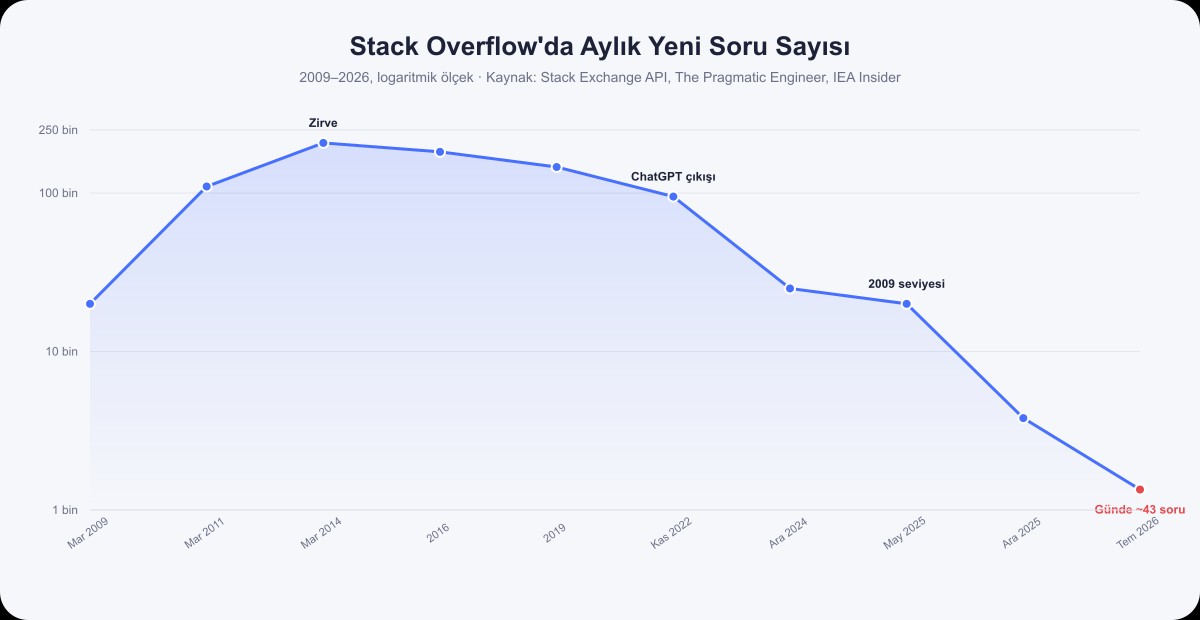
Put 207,189 in 2014 next to 1,346 in 2026 and the drop is 99.4%. In other words the site has shrunk by more than a hundredfold from its peak, and on this chart the line isn't a steady slope but a cliff that steepens from the end of 2022.
A strange paradox: the community is dying, the company is profitable
This is where things take an unexpected turn. While the community has gone almost completely quiet, Stack Overflow's figures in Prosus's reports move in exactly the opposite direction: in the financial year ending March 2025 it reported $115 million in revenue, up on the previous period. Losses also fell from $84 million to $22 million.
The reason for this reversal is simple: Stack Overflow now licenses its huge human-written Q&A archive to AI companies. The deal signed with OpenAI in May 2024 lets ChatGPT use Stack Overflow posts (and credit the community). A similar deal had already been made with Google to train Gemini. And in February 2026, Stack Overflow launched a "pay-per-crawl" system with Cloudflare: AI bots now pay in real time to crawl the site.
To sum up: the AI companies that dried up the community are now paying to access the legacy of that dried-up community.
This isn't a story unique to Stack Overflow either. In its IPO prospectus in February 2024, Reddit disclosed $203 million in data licensing deals, including an annual $60 million deal with Google. In the second quarter of 2025, AI licensing revenue alone reached $35 million, about 10% of Reddit's total revenue. Axel Springer, the Financial Times, Condé Nast and the Associated Press have signed similar deals. And the reason is academic: a study published in Nature in 2024 (Shumailov et al.) showed that AI models lose information when trained on other AI output. So clean, human-generated data is becoming more valuable precisely as these archives dry up.
So is it really "over"?
To be honest: Stack Overflow's flow of new questions really has come to a standstill, but the site still pulls in huge traffic as a reference library. Millions of developers still search Google for an error message and land on a Stack Overflow answer from 2013; it's just that nobody asks new questions any more.
An academic study published in December 2025 (by Wu, Ajmani, TeBlunthuis and Li, at the ACM CSCW conference) argues that summing up the collapse as just "AI arrived and the community died" is superficial. The researchers analysed 2,070 posts on Meta Stack Exchange and interviewed 14 participants. Their conclusion: over the years the company's governance shifted from "deciding together" to "just informing", and that wore down community commitment. AI threw the last spark onto a fire that was already burning; it didn't start it.
So the picture is this: the moderation crackdown of 2014 cooled the community, a second wave of decline came after the pandemic, and ChatGPT steepened a curve that was already falling. Looking for a single villain oversimplifies the story.
What changed for me?
As I mentioned in the post about my experience working with AI agents, when I hit an error now I ask Claude Code first, not Google. But I have to admit I don't think Stack Overflow is completely useless. Last week, chasing an old PostgreSQL index problem, I landed on a 2016 Stack Overflow answer again. In a comment under the answer, someone had noted, "Watch out if you're on this version." That note came from someone who had actually had that problem one night. AI doesn't tell me that, because it never lived through "that night".
I won't claim Stack Overflow will shut down completely. The data doesn't say that; it only says the company's business model is no longer "new questions and answers" but "archive licensing". But one thing is certain: the reflex that was every developer's daily habit for more than a decade (copy the error message, paste it into Google, click the Stack Overflow link) is, for a whole generation, as if it never existed.
Sources
The data in this post is compiled from: Gergely Orosz, Stack overflow is almost dead, The Pragmatic Engineer (May 2025); Stack Exchange Data Explorer and the official Stack Exchange API; IEA Insider, The data licensing gold rush (April 2026); Wu, Ajmani, TeBlunthuis, Li, AI Didn't Start the Fire, ACM CSCW (December 2025, arXiv:2512.08884); Shumailov et al., AI models collapse when trained on recursively generated data, Nature 631 (2024).

Cantürk Çelikok
Freelance full stack developer based in Ankara, Türkiye. He built live products such as PlusTurk, Nerdesin, Ayda POS and Songnaria Coffee end to end, and shares the notes from those projects here.